Car donation comes with its own vocabulary. From titles and liens to Form 1098-C and gross proceeds, the terminology can slow down an otherwise simple process. This glossary breaks down every term you are likely to encounter when donating a vehicle to Vehicles For Veterans, in plain language, with links to deeper resources where they […]
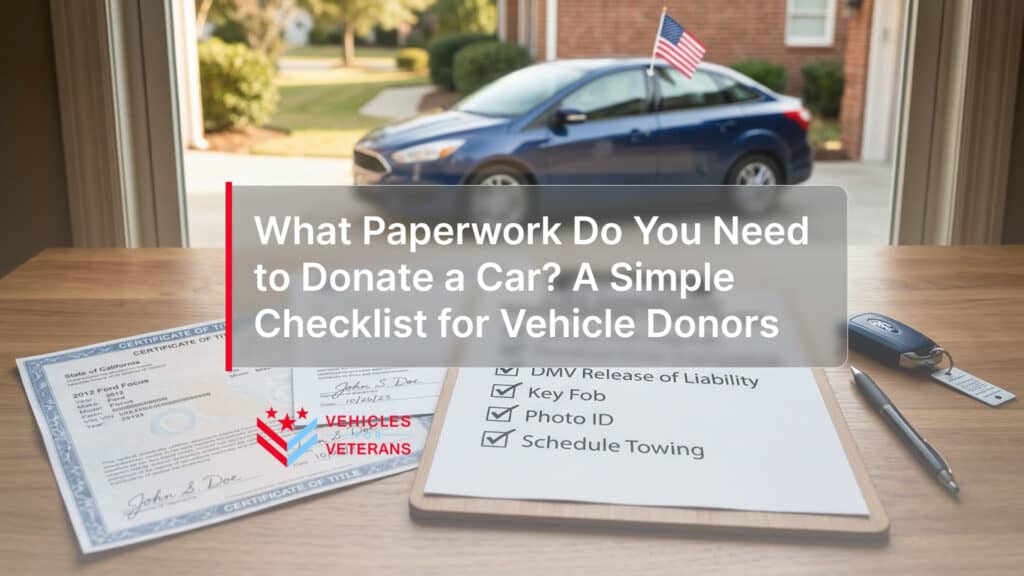
What Paperwork Do You Need to Donate a Car? A Simple Checklist for Vehicle Donors
If you're thinking about donating your car to Vehicles For Veterans but feeling uncertain about the paperwork involved, you're not alone. Paperwork anxiety is one of the top reasons people hesitate to donate—right alongside concerns about vehicle condition. The good news? Donating your car requires less paperwork than you think, and we're here to guide you through exactly what you need.
This straightforward guide walks you through every document required for vehicle donation, state-by-state variations, and common title situations. By the end, you'll feel confident about the process and ready to turn your unwanted vehicle into support for American veterans charity programs.
The Essential Document: Your Vehicle Title
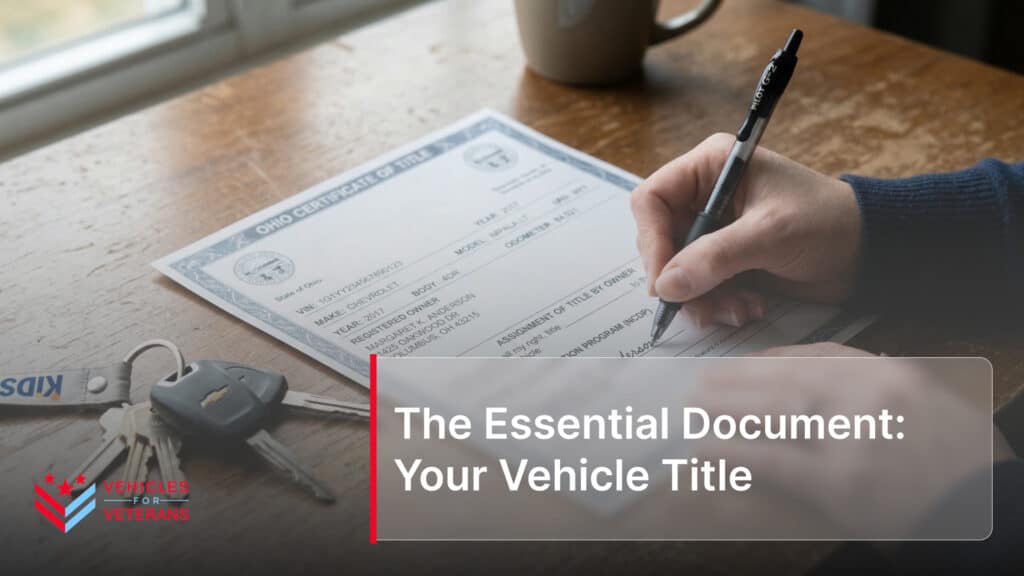
The single most important piece of paperwork for car donation is your vehicle title. This document proves you own the vehicle and gives you legal authority to donate it. Without a clear title in your name, we cannot process your donation.
Your title includes critical information: the vehicle identification number (VIN), year, make, model, and registered owner name. When you donate, you'll sign the title in the "Assignment of Title by Owner" or "Transfer of Ownership" section—basically the same section you'd complete if selling the vehicle privately.
Important signing rules:
- Sign your name exactly as it appears on the front of the title
- Don't sign until you're ready—some states require notarization, which means signing in front of a notary public
- If two owners are listed with "and" between names, both must sign
- If two owners are listed with "or" between names, only one signature is required
- Never cross out mistakes, white them out, or initial over errors—this voids the title
If you make a signing error, call us at 1-855-811-4838. We can help you obtain the necessary correction forms rather than applying for an entirely new title.
State-by-State Paperwork Requirements
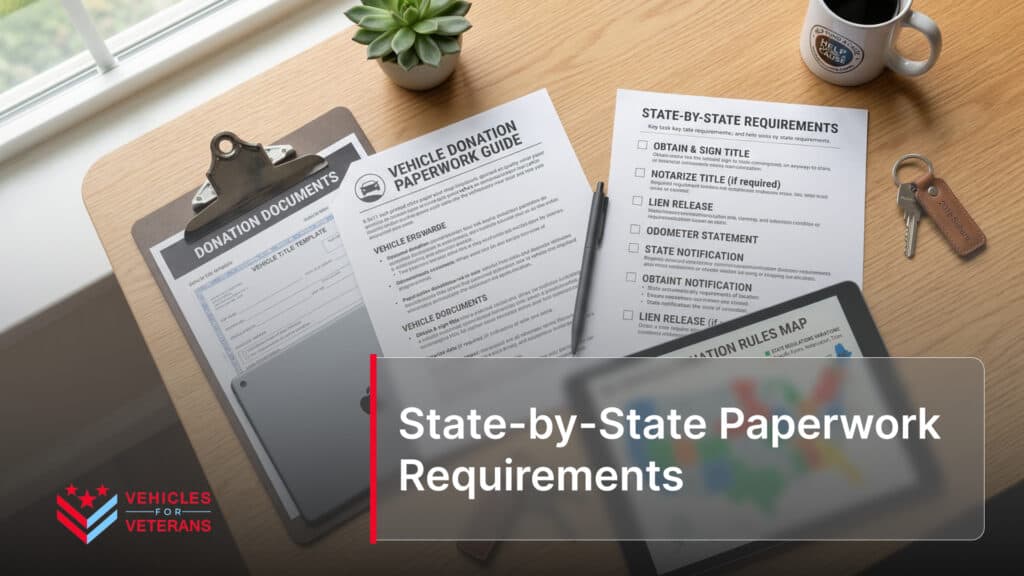
Vehicle donation paperwork varies significantly by state. Here's what you need to know based on where your vehicle is registered:
States Requiring Notarized Title Signatures
These states require you to sign your title in the presence of a notary public, who will verify your identity and witness your signature:
- Arizona
- Kentucky
- Louisiana
- Montana
- North Carolina
- Ohio
- Oklahoma
- Pennsylvania
- Wyoming
Don't sign your title before visiting the notary. Bring valid photo ID and sign while the notary watches. The notary will then sign and stamp your signature as official. Most banks, UPS stores, and shipping centers offer notary services, often free for account holders.
States Requiring Release of Liability or Notice of Transfer
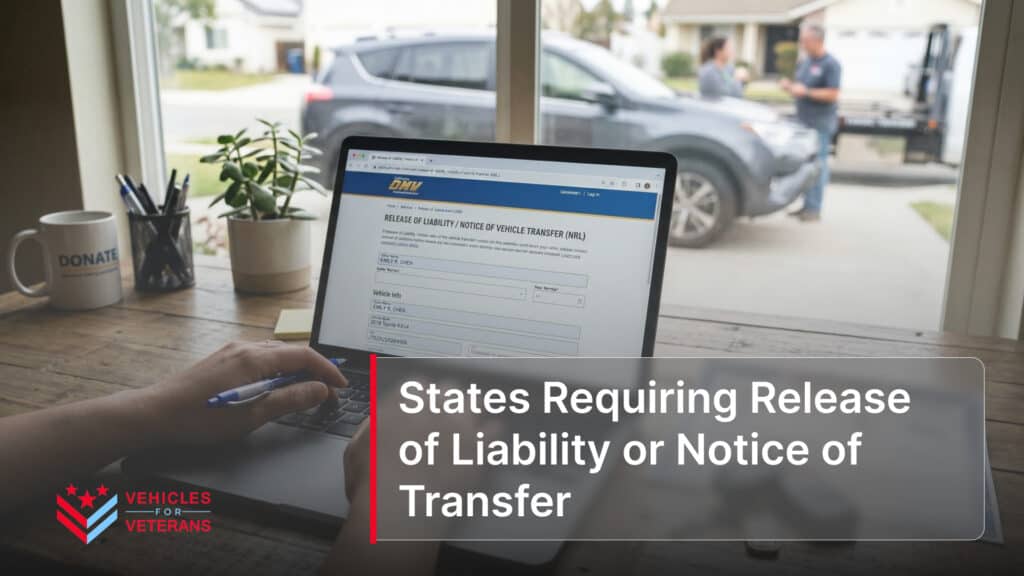
After your vehicle is picked up, these states require you to file paperwork notifying the DMV you no longer own the vehicle. This protects you from future liability for parking tickets, traffic violations, or registration fees:
- Alaska
- California (within 5 days)
- Colorado
- Florida
- Illinois
- Iowa
- Louisiana
- Minnesota
- Mississippi
- Missouri
- Oregon
- South Carolina
- Texas
- Washington
Most states allow you to complete this notification online, which is the fastest method and provides a timestamped receipt for your records. Some states offer mail or in-person options. Complete this step after your vehicle is picked up, not before.
License Plate Requirements
License plate rules vary:
States requiring plate removal and return to DMV: Many states require you to remove your plates before or immediately after donation and either return them to the DMV or transfer them to another vehicle you own. Call us at 1-855-811-4838 and we'll tell you exactly what your state requires.
States allowing plates to remain: Some states, like California, require plates to stay on the vehicle. We handle removal and proper disposal according to state law after pickup.
Don't remove plates if your vehicle is parked on a public street—you could receive citations. Wait until pickup day or move the vehicle to private property first.
Common Title Situations and Solutions

Lost or Missing Title
Lost your title? You can still donate once you obtain a duplicate. Contact your state's DMV to request a replacement title. Most states allow online applications, though processing times vary from a few days to several weeks.
You'll typically need:
- Photo ID (driver's license)
- Vehicle registration or VIN
- Small fee (usually $10-$30)
- Proof of ownership in some states
Some states offer expedited processing for an additional fee if you need the title quickly. Call us while you're waiting for your duplicate—we can schedule your donation for after the title arrives.
Lien on Your Title
If your title shows a lien holder (bank or finance company), you must pay off the loan before donating. Once paid off, the lien holder provides a lien release—either a separate document or by signing the lien release section on your title.
If you've paid off your loan but the lien holder didn't provide release paperwork, contact them directly. We can help by requesting the lien release on your behalf if you provide written authorization and a copy of your driver's license.
Title in Someone Else's Name
The person listed on the title must sign as the seller. If you're trying to donate a vehicle titled in someone else's name, you have a few options:
Vehicle titled in a living family member's name: You'll need power of attorney allowing you to sign on their behalf.
Vehicle titled in a deceased person's name: Requirements vary by state but typically include:
- Copy of death certificate
- Executor rights paperwork or probate documents
- Title signed by the executor using both the deceased person's name and their own
Call us at 1-855-811-4838 and we'll explain exactly what your state requires for this situation.
Title Errors or Alterations
If your title has cross-outs, white-outs, or corrections, it's likely void. Don't attempt to sign over a damaged title—contact your state DMV for correction procedures. Most states offer a correction form that's faster and cheaper than requesting a completely new title.
IRS Tax Paperwork for Your Deduction
The tax paperwork you receive depends on your vehicle's final value:
Donations Valued at $500 or Less
If your vehicle sells for $500 or less at auction or generates $500 or less through recycling, you'll receive a basic donation receipt. You can claim up to $500 or the fair market value (whichever is less) without additional IRS paperwork.
Keep your receipt with your tax records. While not required to attach it to your return, you'll need it if audited.
Donations Valued at $501 to $5,000
If your vehicle sells for more than $500, we'll send you IRS Form 1098-C showing the exact gross proceeds. The IRS requires charitable organizations to file this form for all vehicle donations exceeding $500 in value.
You'll receive Form 1098-C within 30 days of your vehicle being sold. Keep Copy B for your records and attach it to your tax return when claiming the deduction. If you e-file, you may need to mail Form 1098-C separately or include it as a PDF attachment, depending on your tax software.
Your deduction equals the actual sale price shown on Form 1098-C, not an estimate of what you think the vehicle is worth.
Donations Valued Over $5,000
For donations exceeding $5,000, you'll also need to complete IRS Form 8283 and may require a written appraisal. This situation is rare for standard vehicle donations but can occur with classic cars, boats, or specialty vehicles.
We recommend consulting a tax professional for donations in this value range to ensure proper documentation and compliance.
What We Handle (and What You Handle)
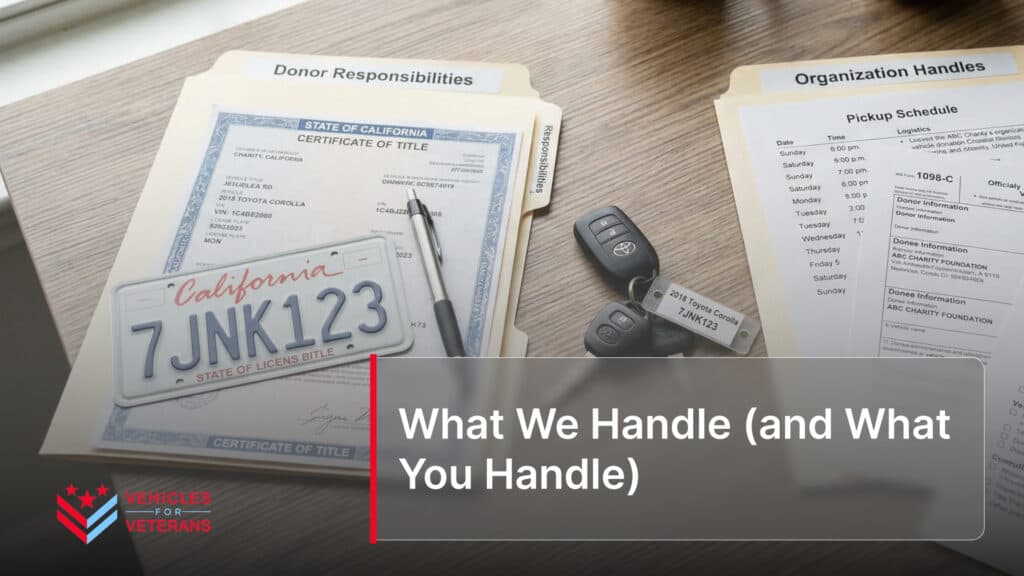
Understanding who handles which paperwork prevents confusion and keeps the donation process smooth:
You handle:
- Locating and signing your title correctly
- Obtaining a duplicate title if yours is lost
- Getting lien releases if applicable
- Filing release of liability/notice of transfer with your state DMV (in states requiring it)
- Removing license plates if your state requires it
- Keeping tax documentation for your records
We handle:
- Scheduling free pickup
- Guiding you through signing requirements for your specific state
- Processing your vehicle through auction or recycling
- Completing the title transfer with state authorities
- Filing IRS Form 1098-C on your behalf
- Sending you proper tax documentation
We help with but cannot handle alone:
- Answering questions about your state's specific requirements
- Explaining what paperwork you need for unusual situations
- Providing guidance on obtaining duplicate titles or lien releases
We're here to support you throughout the process, but certain paperwork legally requires your personal action. When in doubt, call us at 1-855-811-4838—we're happy to explain exactly what you need to do for your situation.
Your Vehicle Donation Paperwork Checklist
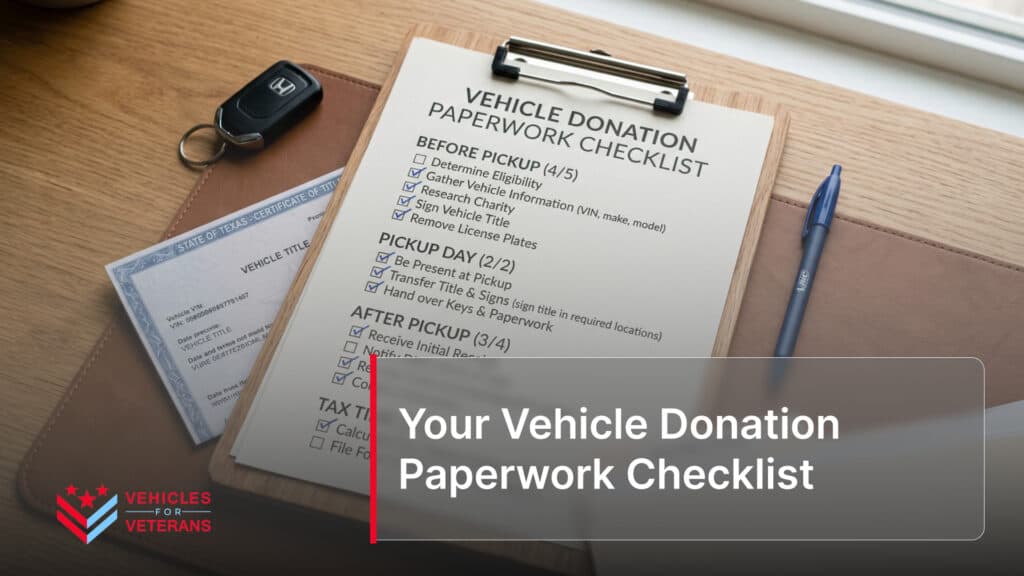
Use this checklist to prepare for your vehicle donation:
Before Scheduling Pickup: ☐ Locate your vehicle title
☐ Verify your name on the title matches your ID
☐ Obtain lien release if there's a lien holder listed
☐ Request duplicate title if yours is lost (allow time for processing)
☐ Confirm whether your state requires notarized signature
☐ Gather photo ID for notary appointment (if required)
On Pickup Day: ☐ Sign title in correct location (wait for notary if required)
☐ Remove license plates if your state requires it
☐ Hand signed title and keys to tow driver
☐ Receive donation tow receipt from driver
After Pickup: ☐ File release of liability/notice of transfer with DMV (if your state requires it)
☐ Cancel vehicle insurance
☐ Return license plates to DMV (if required)
☐ Keep donation receipt in tax records
Tax Time: ☐ Receive Form 1098-C if vehicle sold for over $500
☐ Attach Form 1098-C to tax return when claiming deduction
☐ Consult tax professional for questions about your specific situation
Supporting American Veterans Through Simple Paperwork
While paperwork might seem daunting, donating your vehicle involves fewer documents and less hassle than selling privately. You're not dealing with multiple potential buyers, negotiating prices, meeting strangers, or worrying about payment fraud. You're completing straightforward paperwork once, with our guidance, and then it's done.
The proceeds from your vehicle donation go directly to benefit American veterans charity programs providing housing assistance, adaptive equipment, mental health services, medical care, service dogs, and community support for veterans and their families. Your paperwork effort—a signed title, maybe a quick DMV filing, and keeping your tax receipt—translates into real, flexible funding for veterans who need it.
Ready to donate your vehicle? Call us at 1-855-811-4838 or complete our online donation form. We'll walk you through exactly what paperwork your state requires and help make the process as simple as possible. American veterans are counting on donors like you to provide the support they've earned through their service.
Related Posts
A Real Donor Was Offered $45,000 for This RV. Tree Damage Changed Everything. Here's What Vehicles For Veterans Got at Auction.
Read More
This is a real story. A veteran with nearly 30 years of service came to us with a 2015 Winnebago Via that had taken $5,500 in tree damage to the roof. A year earlier, the largest retailer of RVs in the U.S. had offered them $45,000 for it. After the damage, they weren't sure what […]
Donate a Work Truck, Van, or Commercial Vehicle to Support Veteran Charities
Read More
That retired work van sitting in your lot still has value — and donating it to Vehicles For Veterans puts that value to work for American veterans charity programs. Call or fill out our online donation form to get started today. Commercial vehicles — box trucks, cargo vans, work pickups, utility trucks, and service vehicles […]
Historic Korean War Military Truck Begins One Last Mission Supporting America's Veterans
Read More
A truck that served America during the Korean War is back on duty. This time, it's supporting the veterans charity programs that serve those who have worn the uniform. If this piece of living history can do its part for veterans, so can your unwanted vehicle. Call or donate online today and put your car […]