That classic, antique, or project car taking up space in the garage can do more good than sitting there. Donating it to Vehicles for Veterans turns it into funding for programs that support veterans nationwide, whether it runs, sits partially disassembled, or hasn't moved in years. Call or fill out our vehicle donation form to […]

Car Donation Terms Explained: A Plain-English Glossary for Vehicle Donors
Car donation comes with its own vocabulary. From titles and liens to Form 1098-C and gross proceeds, the terminology can slow down an otherwise simple process. This glossary breaks down every term you are likely to encounter when donating a vehicle to Vehicles For Veterans, in plain language, with links to deeper resources where they genuinely help. Ready to donate now? Call 1-855-811-4838 or fill out our online donation form and our team will guide you through every step.
Title Terms
Vehicle Title (Certificate of Title)
The legal document that proves you own your vehicle. It is the single most important piece of documentation in the donation process. Without a title in your name, the transfer of ownership cannot be completed in most states. It lists your name, the vehicle identification number, make, model, year, and any lien holders. Learn how to correctly fill out your vehicle title when donating your car.
Clear Title
A title that is free of liens, errors, alterations, and legal encumbrances. A clear title in your name is required to donate in most states. If your title has cross-outs, white-out, or water damage, it may not be considered clear and could be void. Review our vehicle donation title FAQ for guidance on what makes a title clear and transferable.
Assignment of Title
The section of your title where you sign to legally transfer ownership to the new party. When donating, you sign as the seller in this section. Leave the buyer information blank — we complete that on our end. Never cross out or correct anything in this section, as doing so voids the title. Our complete documentation guide covers exactly where and how to sign your title for donation.
Transferable Title
A title that is legally eligible to be signed over to another party. Factors that can make a title non-transferable include active liens, errors or alterations, damage that renders information illegible, or a title that has already been signed over to someone else. See what vehicles we accept and what documentation is required.
Duplicate Title
A replacement title issued by your state DMV when the original is lost, stolen, or damaged. Most states offer duplicate titles online, in person, or by mail, with processing times ranging from a few days to several weeks. You can schedule your donation in advance while waiting for your duplicate to arrive. Our donation paperwork checklist walks through the duplicate title process and every other document you will need.
Salvage Title
A title designation indicating that a vehicle was declared a total loss by an insurance company, typically because repair costs exceeded a threshold percentage of the vehicle's value. Vehicles with salvage titles may still be accepted for donation on a case-by-case basis. Find out more about donating older and salvage-titled vehicles.
Title Correction Form
A form available through most state DMVs that allows errors on a title to be corrected without requiring a completely new duplicate title. This is typically faster and cheaper than applying for a duplicate. Common fixable errors include misspelled names and incorrect vehicle information. Never attempt to correct a title yourself by crossing out or writing over existing information — a corrected or voided title cannot be used for transfer.
Lien
A legal claim held by a lender against your vehicle as security for an outstanding loan. If a lien holder such as a bank or credit union is listed on your title, the loan must be paid off and the lien released before the vehicle can be donated. The lien holder's name appears on the front of your title in the legal owner section.
Lien Release
A document from your lender confirming that a loan has been paid off and the lender no longer has a legal claim to the vehicle. It may come as a separate letter on the lender's letterhead or as a stamp on the title reading "LIEN RELEASED." Without a lien release, a title with a lien holder listed cannot be transferred. In some cases, with your written authorization, we can request lien releases from lenders on your behalf. See how lien releases fit into the broader step-by-step donation process.
Notarized Signature
In certain states, your signature on the vehicle title must be witnessed and certified by a licensed notary public. If your state requires notarization, do not sign the title beforehand — you must sign it in front of the notary, who will verify your identity and apply their official seal. Notaries are available at most banks, UPS stores, FedEx Office locations, and law offices. States currently requiring notarized title signatures include Arizona, Kentucky, Louisiana, Montana, Nebraska, North Carolina, Ohio, Oklahoma, Pennsylvania, and Wyoming. Requirements can change, so always confirm with our team before signing.
Release of Liability / Notice of Transfer
A filing you submit to your state DMV after your vehicle is picked up, notifying them that ownership has transferred and you are no longer responsible for the vehicle. This protects you from future parking tickets, traffic violations, toll charges, or registration fees tied to the vehicle after donation. Most states allow online filing. Complete this step promptly after pickup. Required states include California, Colorado, Florida, Illinois, Iowa, Minnesota, Missouri, Oregon, Texas, Washington, and others. Learn how to prepare your vehicle and complete post-donation requirements correctly.
Odometer Disclosure
A state-required disclosure of the vehicle's mileage at the time of transfer, typically recorded on the title itself or on a separate odometer statement. Federal law requires odometer disclosure for most vehicles under ten years old. We record the odometer reading at the time of pickup, so you typically do not need to fill this in yourself.
Co-Owner / Joint Title
A title listing two owners. Whether both owners need to sign depends on how the names are joined. If the names are connected by "and," both must sign. If connected by "or," either owner may sign alone. Rules for titles with no conjunction between names vary by state — call us to confirm what your state requires.
Power of Attorney (POA)
A legal document authorizing one person to act on behalf of another, including signing a vehicle title for donation purposes. The POA must specifically grant authority to sell or transfer vehicles, must be notarized in most states, and must be the original or a certified copy. When signing under POA, sign both the owner's name and your own indicating your role. Example: "John Smith by Jane Smith, Attorney-in-Fact."
Deceased Owner Title Transfer
The process of donating a vehicle whose title is in the name of someone who has passed away. Requirements vary significantly by state but generally include the original title, a certified copy of the death certificate, and executor paperwork establishing legal authority to transfer the vehicle. Call us and we will explain exactly what your state requires for your specific situation.
Letters Testamentary / Executor Rights
An official court document issued during probate that grants an executor the legal authority to manage and distribute a deceased person's estate, including transferring vehicle titles. Also referred to as Letters of Administration or Letters of Representation depending on the state. When donating a vehicle from an estate, this document is typically required alongside the death certificate and original title. Call us at 1-855-811-4838 and our team will walk you through what your state requires.
Tax Terms
Fair Market Value (FMV)
The price a willing buyer would pay a willing seller for a vehicle, with neither party under pressure and both having reasonable knowledge of the relevant facts. For car donations, FMV matters most when your vehicle sells for $500 or less — in that case, you may deduct up to $500 or the FMV, whichever is less. Resources like Kelley Blue Book or NADA Guides are commonly used to estimate FMV. Get a full breakdown of how car donation tax deductions work under current IRS rules.
Gross Proceeds
The total amount your donated vehicle sells for at auction before expenses are deducted. For vehicles that sell for more than $500, your tax deduction is limited to the gross proceeds from the sale or the FMV, whichever is less. This is the figure that appears on your IRS Form 1098-C and determines your deduction. It reflects the real market value your vehicle achieved, not an estimate. Review our FAQ for more on how gross proceeds determine your tax deduction.
IRS Form 1098-C
The IRS form specifically designed for donations of motor vehicles, boats, and airplanes. We file this form on your behalf and mail you Copy B within 30 days of your vehicle's sale, provided the vehicle sold for more than $500 and you have supplied your Social Security Number. You attach this form to your tax return when claiming your deduction. Learn more about your tax deduction and what documentation you will receive after your donation.
IRS Form 8283
The IRS form for reporting noncash charitable contributions. You must file Form 8283 if your total deduction for all noncash contributions exceeds $500 for the year. For vehicle donations where your deduction is limited to gross proceeds and you have a contemporaneous written acknowledgment such as Form 1098-C, the IRS specifically designates donated vehicles as Section A items regardless of sale price. Section B, which requires a qualified appraisal, does not apply to standard vehicle donations sold at arm's length through our program. Consult a tax professional for guidance on your specific situation.
501(c)(3)
The section of the IRS tax code that designates an organization as a tax-exempt nonprofit. To claim a tax deduction for your vehicle donation, the organization you donate to must hold current 501(c)(3) status. Car Donation Foundation d/b/a Vehicles For Veterans is a federally registered 501(c)(3) nonprofit, EIN 26-3408048. You can verify our status directly through the IRS Tax Exempt Organization Search tool. Learn how to verify a charity's 501(c)(3) status and identify legitimate donation programs before you donate.
Tax-Deductible Receipt
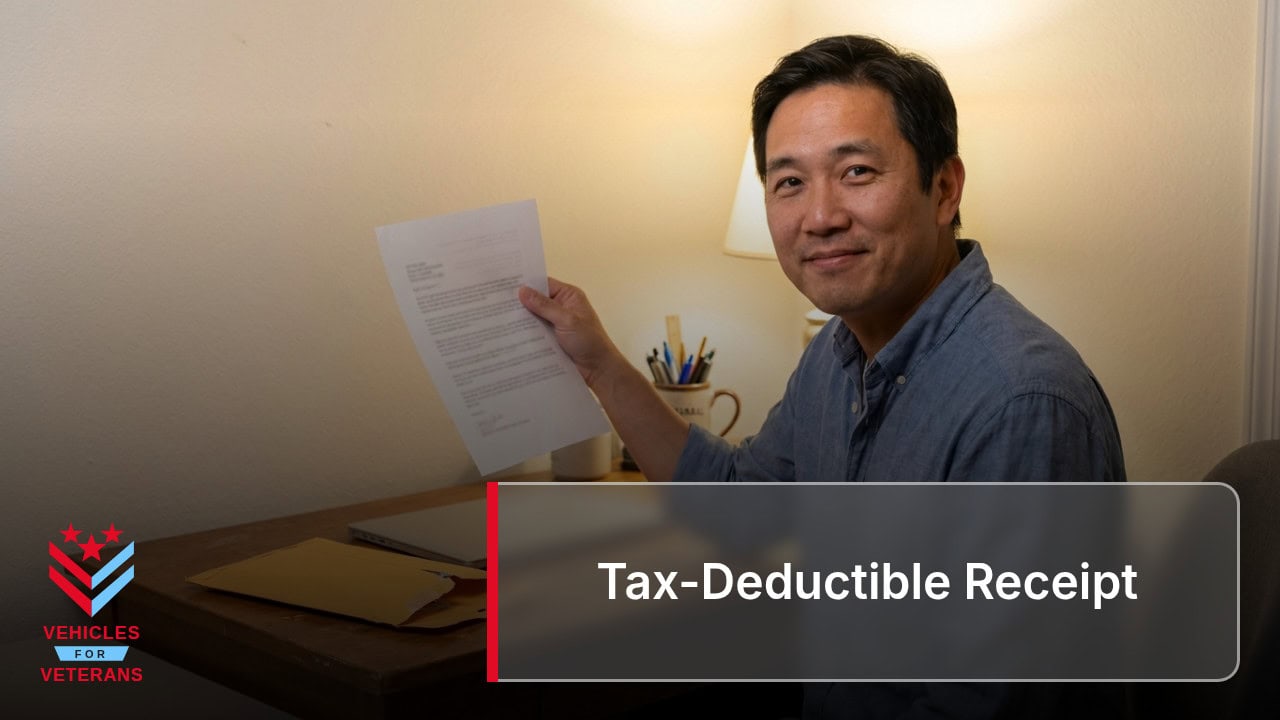
The documentation you receive confirming your donation and the value on which your tax deduction is based. You will receive a preliminary receipt shortly after pickup and, if your vehicle sells for more than $500, a final receipt reflecting the actual sale price. Keep all receipts with your tax records. See how Vehicles For Veterans compares to other programs when it comes to tax documentation and proceeds.
Preliminary Tax Receipt
The initial receipt mailed or emailed to you after your vehicle is confirmed as picked up. This document serves as proof of donation and is sufficient for tax purposes if your vehicle ultimately sells for $500 or less. If your vehicle sells for more, a follow-up receipt reflecting the actual sale price is sent separately along with IRS Form 1098-C. See what happens to your vehicle after pickup and how its final value is determined.
Itemized Deduction
A method of reducing your taxable income by listing individual deductible expenses on Schedule A of IRS Form 1040, rather than taking the standard deduction. Car donation tax deductions are only available to donors who itemize. If your total deductions do not exceed the standard deduction for your filing status, the donation's tax benefit may be limited. Consult a tax professional for advice specific to your situation.
Schedule A (IRS Form 1040)
The IRS schedule used to list itemized deductions on your federal tax return. Charitable contributions, including vehicle donations, are reported on Schedule A. If you take the standard deduction instead of itemizing, you cannot claim a vehicle donation deduction on your federal return.
Social Security Number (Required for Form 1098-C)
The IRS requires us to collect your Social Security Number in order to issue Form 1098-C for vehicles that sell for more than $500. You will be asked to provide it after your vehicle is picked up and sold. Without your SSN, we cannot file the 1098-C and you cannot claim the full sale price as your deduction. Our SSN collection process is secure.
IRS Publication 4303
The IRS's official guide titled "A Donor's Guide to Car Donations." This publication outlines the rules for vehicle donation deductions, documentation requirements, and how deduction amounts are determined. It is the definitive IRS reference for anyone donating a vehicle to charity and is linked directly from our tax information page.
American Jobs Creation Act of 2004
The federal legislation that changed car donation tax rules beginning January 1, 2005. Before this law, donors could deduct the fair market value of their vehicle regardless of what it actually sold for. After the Act, deductions for vehicles selling over $500 were limited to actual gross sale proceeds. This change eliminated inflated deduction claims and brought accuracy and accountability to vehicle donation tax benefits.
Tax Write-Off
A common informal term for a tax deduction. When you donate your vehicle to Vehicles For Veterans, the value at which it sells at auction becomes your tax write-off, subject to IRS rules. For vehicles selling under $500, the write-off is up to fair market value capped at $500. For vehicles selling over $500, the write-off equals the gross sale proceeds. Understand how legitimate programs handle tax write-offs and what red flags to watch for.
Written Acknowledgment
The IRS requires a written acknowledgment from the receiving organization for any charitable contribution of $250 or more. For vehicle donations, this acknowledgment is fulfilled by the tax receipt or Form 1098-C we send you. It must include your name, the vehicle description, the donation date, and a statement that no goods or services were provided in exchange. See how even lower-value vehicles still generate proper written documentation and a real contribution.
Non-Cash Charitable Contribution
Any charitable donation that is not cash or a cash equivalent. Vehicle donations are non-cash charitable contributions, which is why they require different IRS documentation than cash donations. The rules governing non-cash contributions are more complex, which is why IRS Form 8283 and Publication 4303 exist specifically to address them.
Process Terms
VIN (Vehicle Identification Number)
A unique 17-character code assigned to every motor vehicle. The VIN is used to identify your specific vehicle throughout the donation process, on title paperwork, and in IRS documentation. You can find your VIN on the driver's side dashboard visible through the windshield, on the driver's side door jamb sticker, or on your title and registration. You will be asked for your VIN when completing the donation form. Start your donation and have your VIN ready.
Case-by-Case Basis
The standard by which we evaluate each vehicle individually rather than applying blanket acceptance or rejection rules. A vehicle's eligibility depends on its condition, location, type, and the cost of processing relative to its likely value. Most vehicles in most conditions are accepted, but we reserve the right to decline a donation when costs would significantly outweigh proceeds. When in doubt, call us and we will give you a straight answer.
Free Towing / Free Pickup
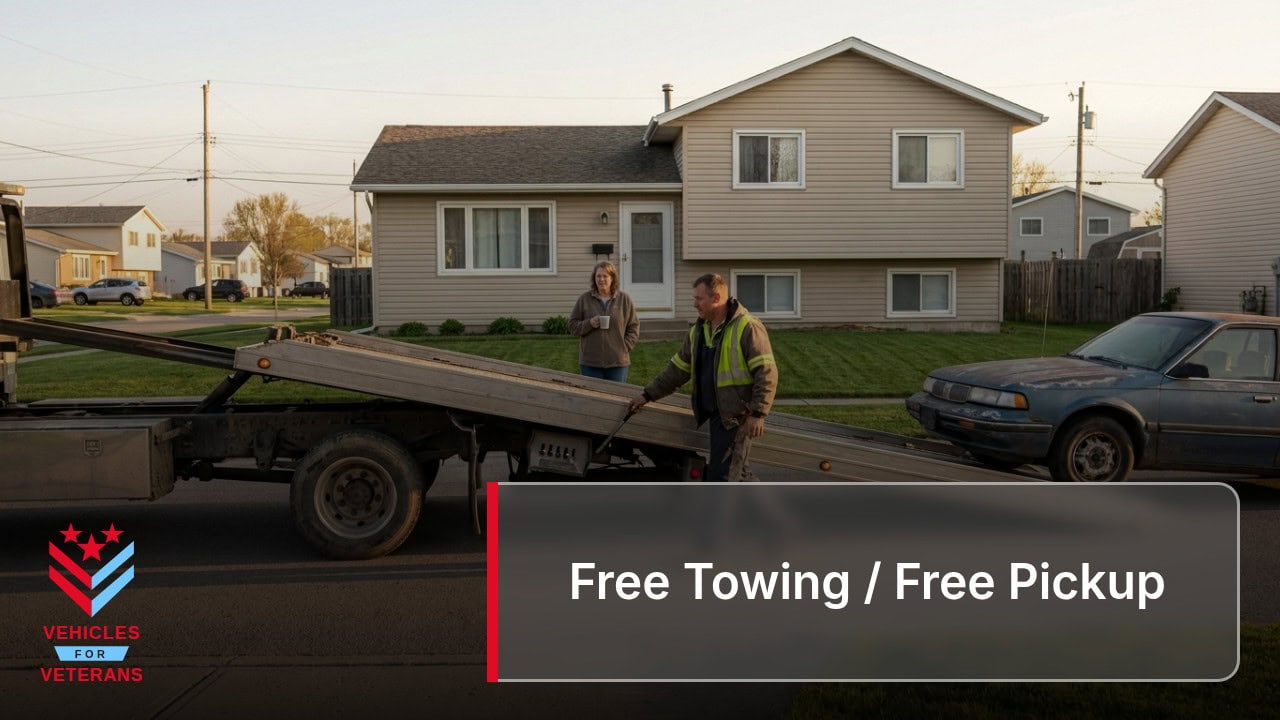
We arrange and pay for towing of your donated vehicle from wherever it is located in the United States, at no cost to you. This applies whether your vehicle is running or not. Towing costs are covered by the program and deducted from the vehicle's sale proceeds, not charged to you. You do not need to arrange transportation or bring the vehicle anywhere. Visit our car donation hub for a complete overview of what the donation service includes.
Pickup Window
The scheduled time period during which the towing company will arrive to collect your vehicle. Pickup windows are typically arranged within 24 hours of the next business day after you complete your donation. The specific window offered depends on towing availability in your area and your scheduling preferences. You do not need to be present for pickup as long as the signed title and keys are accessible.
Processing Partner
The third-party company we work with to tow, process, and sell donated vehicles. When you complete your donation, your vehicle is assigned to the nearest processing partner, who will contact you to schedule pickup. Processing partners operate the auction and recycling channels through which your vehicle is sold and are vetted by our program to ensure vehicles are handled in a way that maximizes proceeds for veterans charities.
Tow Receipt / Donation Receipt
The document provided by the tow driver at the time of pickup confirming that your vehicle was received. This is your initial proof of donation and includes the date, vehicle description, and basic donor information. It is separate from the tax receipt you receive after the vehicle sells. Keep both documents with your tax records.
Auction
The primary channel through which donated vehicles are sold to generate proceeds for veterans charities. Vehicles are evaluated and sent to auction where buyers bid competitively. The final hammer price becomes the gross proceeds that determine your tax deduction. Auction is the preferred path for vehicles with resale value because competitive bidding typically yields stronger results than direct sale.
Recycling / Scrap Value
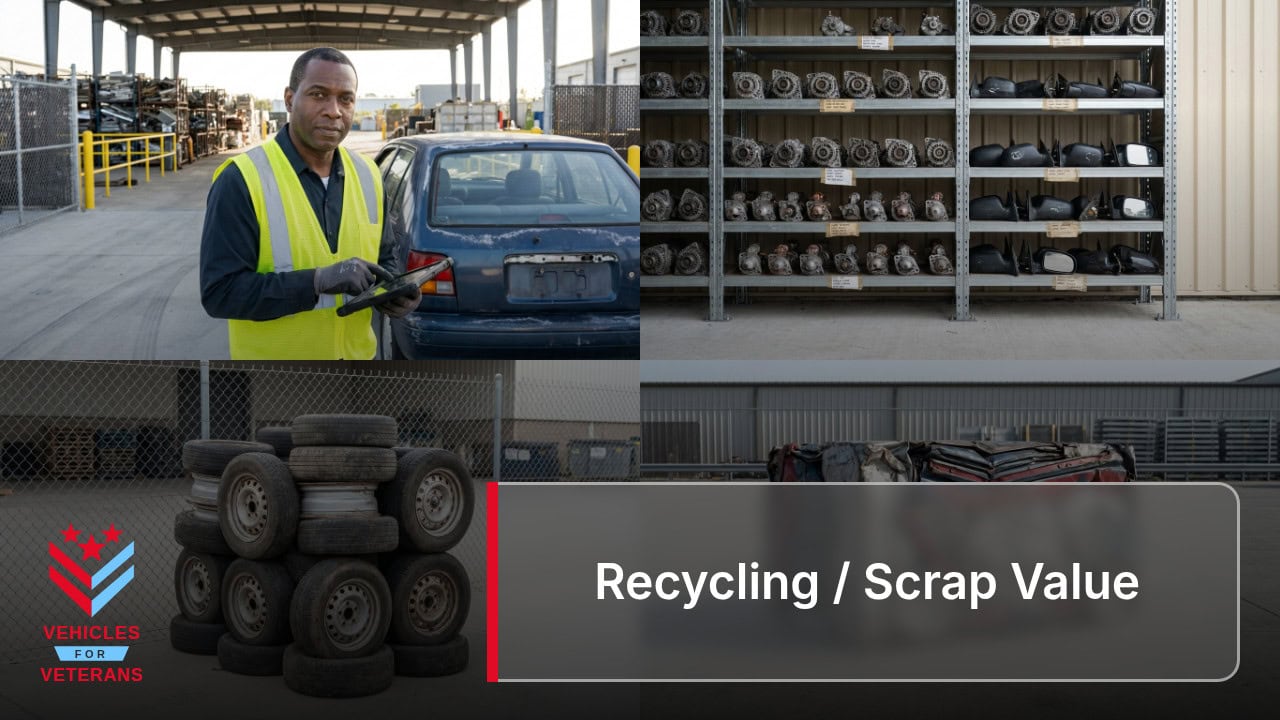
When a vehicle cannot be resold at auction, it is processed through recycling. Scrap metal markets assign value based on weight and material composition, with steel and aluminum being the primary commodities. Even a non-running vehicle with no resale market still generates real proceeds through recycling, and those proceeds still benefit veterans charity programs.
Donee Organization
The IRS term for the nonprofit organization receiving your donated vehicle. In your donation, that is Car Donation Foundation d/b/a Vehicles For Veterans. The donee organization is responsible for filing Form 1098-C, providing written acknowledgment, and ensuring proper title transfer. The IRS requires that the donee be a qualified tax-exempt organization for your deduction to be valid. Learn more about Vehicles For Veterans as an organization.
Partner Organizations
The American veterans charities that receive proceeds generated by your vehicle donation. Car Donation Foundation d/b/a Vehicles For Veterans distributes proceeds to a network of established veterans charities providing housing assistance, mental health support, adaptive equipment, service dogs, and community resources to veterans and their families nationwide. See our full list of partner organizations.
Have a question about a term not covered here? Call 1-855-811-4838 or fill out our online donation form and our team will walk you through anything you need to know. Every donation goes to work for American veterans charity programs, and we are here to make sure the process is clear from start to finish.
Related Posts
Car Donation Terms Explained: A Plain-English Glossary for Vehicle Donors
Read More
Car donation comes with its own vocabulary. From titles and liens to Form 1098-C and gross proceeds, the terminology can slow down an otherwise simple process. This glossary breaks down every term you are likely to encounter when donating a vehicle to Vehicles For Veterans, in plain language, with links to deeper resources where they […]
A Real Donor Was Offered $45,000 for This RV. Tree Damage Changed Everything. Here's What Vehicles For Veterans Got at Auction.
Read More
This is a real story. A veteran with nearly 30 years of service came to us with a 2015 Winnebago Via that had taken $5,500 in tree damage to the roof. A year earlier, the largest retailer of RVs in the U.S. had offered them $45,000 for it. After the damage, they weren't sure what […]
Donate a Work Truck, Van, or Commercial Vehicle to Support Veteran Charities
Read More
That retired work van sitting in your lot still has value — and donating it to Vehicles For Veterans puts that value to work for American veterans charity programs. Call or fill out our online donation form to get started today. Commercial vehicles — box trucks, cargo vans, work pickups, utility trucks, and service vehicles […]